Concrete moisture testing is essential because trapped sub-slab vapor creates hydrostatic pressure that destroys bond adhesion, causing epoxy flooring to blister, peel, and delaminate within months. Professional contractors across Placer County utilize calibrated in-situ relative humidity testing to verify that concrete slabs meet strict manufacturer moisture thresholds before resin application.
When property owners invest in high-performance resinous coatings, ensuring long-term structural integrity requires comprehensive sub-floor analysis. [demo_data field=business_name] mandates rigorous pre-installation moisture diagnostics across residential garages, basements, and workshops throughout Roseville, Rocklin, Granite Bay, Lincoln, Loomis, Citrus Heights, and Folsom.
The Science of Sub-Slab Moisture Migration
Concrete is a porous, sponge-like composite material containing millions of microscopic capillaries. When a concrete slab is poured, water is mixed into the aggregate and cement paste to initiate the chemical hydration process. However, only a fraction of that water is chemically consumed; the remainder constitutes excess mix water that must eventually evaporate out of the slab.
Furthermore, concrete slabs poured directly on grade—the standard construction method for residential homes across the Greater Sacramento valley—are continuously exposed to subterranean moisture. Groundwater, high regional water tables, and saturated clay soils exert constant vapor pressure upward against the underside of the foundation. If an impermeable epoxy or polyaspartic coating is sealed directly over a damp slab without testing, moisture vapor becomes trapped beneath the film.
Primary Concrete Moisture Test Methods
Industry standards dictate specific testing protocols to quantify moisture levels accurately before applying resinous systems. Choosing the correct test method ensures that flooring manufacturers uphold their material warranties.
| Test Method & Standard | Measurement Parameter | Description & Execution |
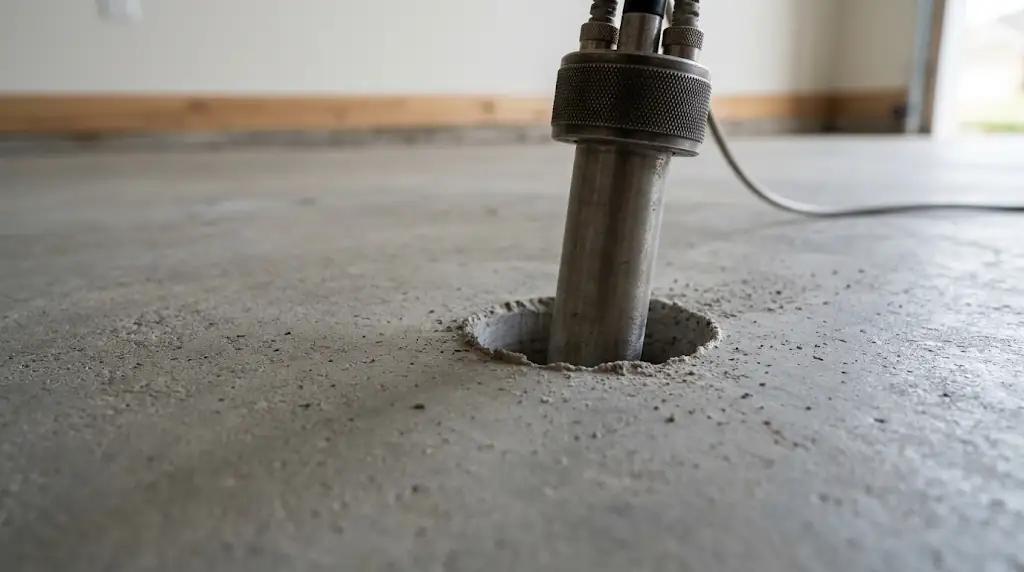
| In-Situ Relative Humidity (RH) (ASTM F2170) | Internal slab moisture percentage | Drilling small holes to 40% of the slab’s depth, inserting calibrated electronic probes, and allowing a 24-hour equilibration window. |
| Calcium Chloride Test (ASTM F1869) | Moisture Vapor Emission Rate (MVER) | Sealing a dish of anhydrous chemical salts under a plastic dome for 60 to 72 hours to measure surface evaporation weight gain. |
| Plastic Sheet Test (ASTM D4263) | Qualitative presence check | Taping an 18×18-inch clear polyethylene sheet tightly to the floor for 24 hours to check for condensation buildup. |
The Mechanics of Coating Failure: Hydrostatic Pressure and Osmosis
When moisture vapor travels upward through a concrete slab and encounters a non-porous polymer barrier like epoxy, it accumulates directly beneath the coating interface. This creates localized hydrostatic pressure.
As vapor pressure builds, it triggers two primary modes of flooring degradation:
- Adhesive Delamination: Water molecules break the chemical bonds between the epoxy primer and the mechanically profiled concrete surface, causing large sections of the floor to lift or pop off.
- Osmotic Blistering: Soluble salts and impurities within the concrete dissolve in the migrating moisture, creating a concentrated solution beneath the coating. Through osmotic pressure, water is pulled through the concrete membrane to dilute the salts, forming pressurized liquid-filled bubbles underneath the epoxy surface.
Regional Climate and Soil Factors in Placer County
Northern California features diverse microclimates that directly influence residential concrete conditions. During wet winter months, heavy atmospheric rivers saturate the region’s prevalent adobe and clay-heavy soils. These expansive soils retain moisture for weeks after rainfall ceases, pressing against garage foundations and increasing sub-slab vapor drive.
Conversely, the intense dry heat of summer causes rapid surface drying while moisture remains trapped deep within the core of thick foundation slabs. Without quantitative testing mandated by guidelines from the ASTM F2170 Organization, visual inspections alone cannot detect these hidden internal moisture imbalances.
Acceptable Moisture Thresholds for Resinous Flooring
Epoxy and polyaspartic coating manufacturers enforce strict technical limits regarding allowable concrete moisture before installation can commence safely. Exceeding these limits requires the implementation of specialized moisture-mitigating primer coats.
| Resinous Coating Layer / System | Maximum Allowable RH (ASTM F2170) | Maximum Allowable MVER (ASTM F1869) |
| Standard Epoxy Primer | Under 75% RH | Under 3 lbs. per 1,000 sq. ft. / 24 hrs |
| Moisture-Mitigating Epoxy Primer | Up to 99% RH | Up to 12 lbs. per 1,000 sq. ft. / 24 hrs |
| Polyaspartic Topcoat System | Under 85% RH | Under 5 lbs. per 1,000 sq. ft. / 24 hrs |
Professional Testing Versus DIY Guesswork
Homeowners occasionally attempt DIY installations using cheap moisture meters or unverified assumptions about how long a concrete slab has been curing. Surface moisture meters only read the top sixteenth of an inch of concrete and are easily skewed by ambient humidity changes or surface temperature variations.
Professional testing uses deep-probe in-situ technology to capture the internal moisture equilibrium of the slab. This data-driven approach guarantees that the specified coating chemistry matches the exact physical condition of your foundation, protecting your investment for decades to come.
Schedule Your Professional Evaluation Today
Eliminating guesswork before a flooring renovation ensures a flawless, permanent finish that withstands local environmental pressures. Roseville Epoxy Flooring performs rigorous sub-slab moisture testing on every project across Roseville, Rocklin, Granite Bay, Lincoln, Loomis, Citrus Heights, and Folsom. Visit our contact page to book your comprehensive concrete evaluation today.